
What You’ll Learn
- Why monthly apartments outperform business hotels for stays over 2 weeks
- Real cost comparison: 30, 60, and 90-day stays
- How to book under a corporate account and get proper invoices
- Best areas in Nagoya by major business district
- What’s included — and what to confirm before signing
Companies sending employees to Nagoya on short- to mid-term assignments face a consistent decision: put them in a business hotel, or find temporary housing. For stays of two weeks or longer, the math almost always favors a monthly apartment. This guide breaks down the real numbers, the booking process for companies, and how to choose the right location.
- Why Monthly Apartments Beat Business Hotels for Assignments Over 2 Weeks
- Real Cost Comparison: Monthly Apartment vs Business Hotel
- How Corporate Bookings Work
- Invoice and Receipt Documentation
- Best Areas in Nagoya by Business District
- What’s Included — Standard Monthly Apartment
- How to Arrange from Overseas
- Frequently Asked Questions
Why Monthly Apartments Beat Business Hotels for Assignments Over 2 Weeks
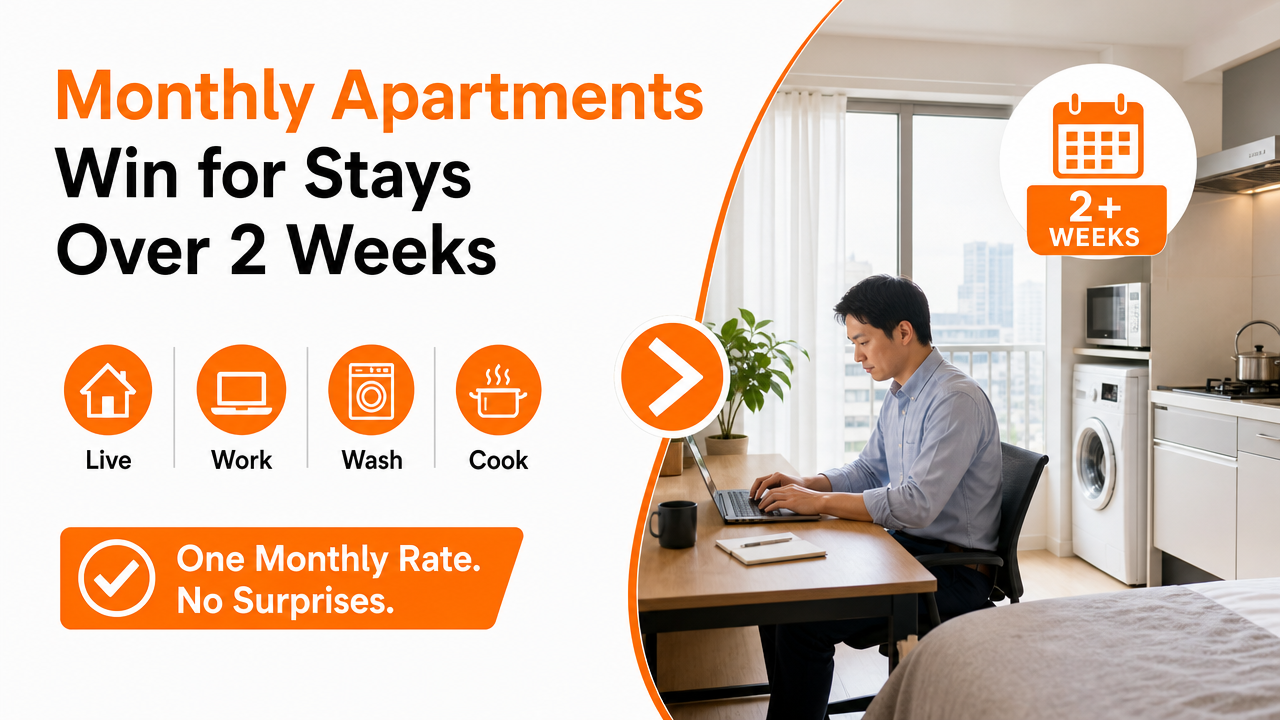
Business hotels are designed for 1–5 night stays. For anything longer, they create friction that compounds over time:
- No kitchen — employees eat every meal out, which adds ¥3,000–¥6,000 per day in food costs alone
- No washing machine — laundry costs or carrying clothes to a coin laundry weekly
- Small workspace — business hotel desks are minimal; no separation between sleeping and working
- Noise and disruption — daily housekeeping, hotel lobbies, constant check-ins and check-outs around you
- No flexibility — rates fluctuate with demand; a conference in the city can double your nightly rate
Monthly apartments solve all of these. They’re fully furnished residential units — with a kitchen, washing machine, desk, and living space — at a fixed monthly rate regardless of season or local events.
Real Cost Comparison: Monthly Apartment vs Business Hotel
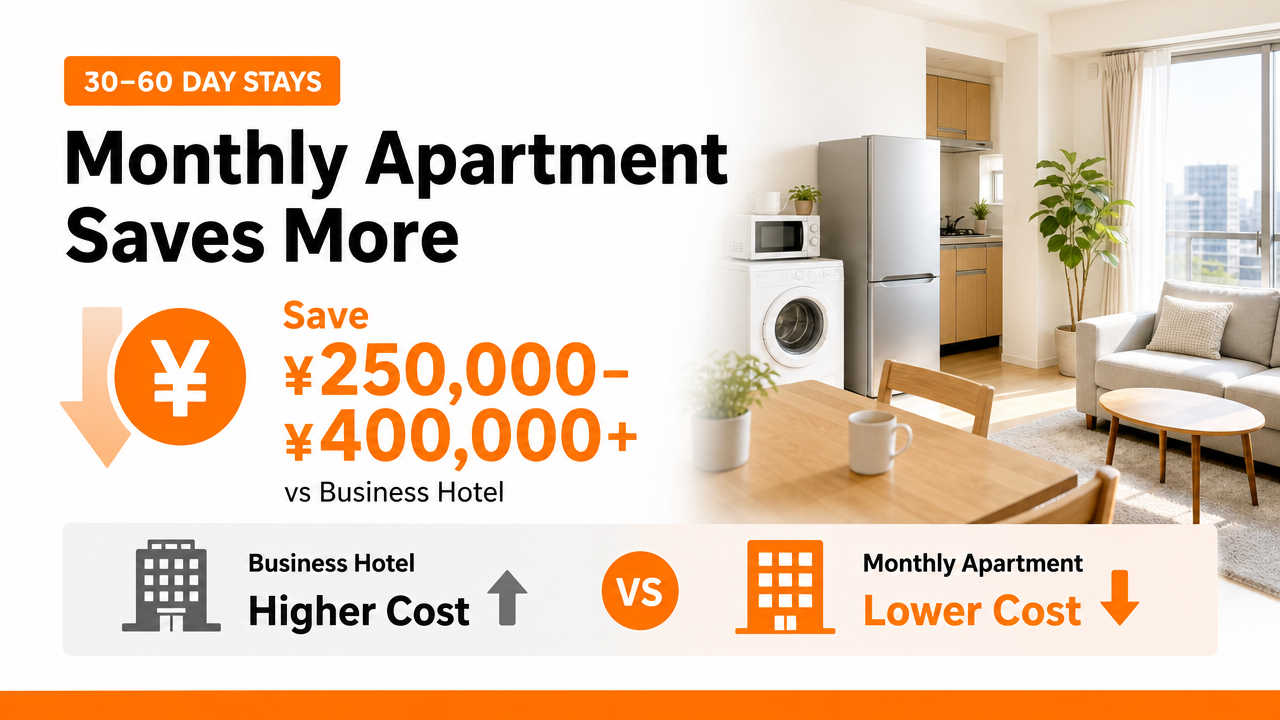
The following figures are based on Nagoya market rates as of 2026.
30-Day Stay (1 Month)
| Business Hotel | Monthly Apartment | |
|---|---|---|
| Accommodation | ¥150,000–¥210,000 | ¥80,000–¥120,000 |
| Meals (eating out daily) | ¥90,000–¥150,000 | ¥40,000–¥60,000 (cooking at home) |
| Laundry | ¥8,000–¥15,000 | ¥0 (washer/dryer included) |
| Total (estimate) | ¥248,000–¥375,000 | ¥120,000–¥180,000 |
60-Day Stay (2 Months)
| Business Hotel | Monthly Apartment | |
|---|---|---|
| Accommodation | ¥300,000–¥420,000 | ¥160,000–¥240,000 |
| Meals | ¥180,000–¥300,000 | ¥80,000–¥120,000 |
| Laundry | ¥16,000–¥30,000 | ¥0 |
| Total (estimate) | ¥496,000–¥750,000 | ¥240,000–¥360,000 |
At 60 days, a monthly apartment saves the company approximately ¥250,000–¥400,000 in total housing and living costs, while providing a significantly better living environment for the employee.
How Corporate Bookings Work

Monthly apartment operators in Nagoya can accommodate corporate contracts. Here’s the typical process:
Option A: Company books directly
The company contacts the operator, negotiates the dates and unit, and handles payment via corporate card or bank transfer. A formal invoice (請求書) is issued to the company. This is the cleanest arrangement for expense management.
Option B: Employee books, company reimburses
The employee books individually and receives a receipt (領収書) or invoice. The employee submits this for expense reimbursement. Works well for shorter assignments where individual booking is faster.
Option C: Pre-negotiated corporate agreement
For companies with recurring assignments to Nagoya (Toyota suppliers, automotive industry, etc.), some operators offer pre-negotiated rates and priority booking. Contact operators directly to discuss volume arrangements.
Invoice and Receipt Documentation
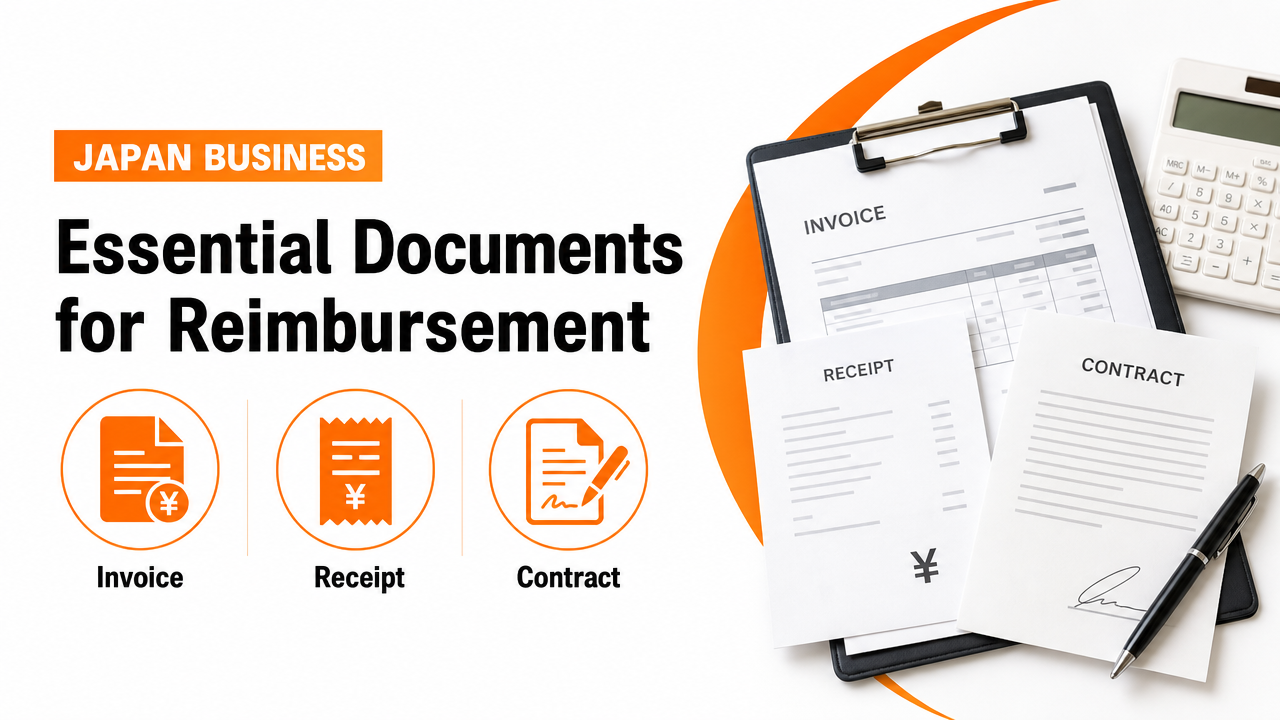
For expense reimbursement and corporate accounting in Japan, ensure the following documents are available:
| Document | Japanese Term | Purpose |
|---|---|---|
| Invoice | 請求書 (Seikyu-sho) | Corporate-to-corporate billing |
| Receipt | 領収書 (Ryōshū-sho) | Proof of payment for individual reimbursement |
| Contract | 契約書 (Keiyaku-sho) | Formal agreement for internal records |
Confirm with the operator before booking which documents they can provide and in what format. Operators used to handling corporate clients will issue these as standard.
Best Areas in Nagoya by Business District
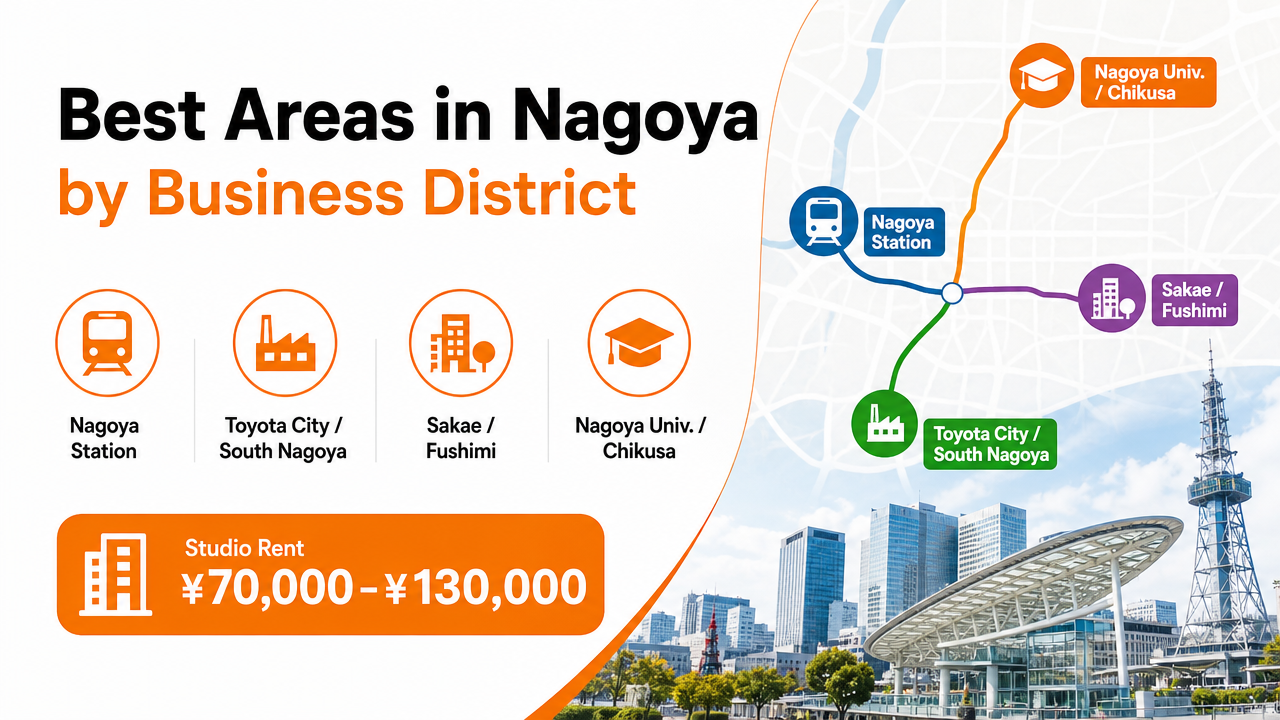
Nagoya’s main business clusters are relatively compact and connected by a reliable subway network.
Toyota City / South Nagoya (Toyoda affiliates, manufacturing)
Employees working at Toyota City headquarters or supplier facilities typically base themselves in Nagoya Station area (15–20 minutes by express train) or Kanayama (good access south without paying premium central prices).
- Recommended: Kanayama or Atsuta area
- Studio monthly rate: ¥75,000–¥105,000
Nagoya Station / Meieki Area (finance, trading, corporate HQ)
The densest cluster of corporate offices in Nagoya. Living within walking distance or one stop is the most convenient option.
- Recommended: Nakamura Ward, Nishi Ward adjacent to Nagoya Station
- Studio monthly rate: ¥95,000–¥130,000
Sakae / Fushimi (professional services, government, retail HQ)
Nagoya’s central business and commercial district. Short commutes to many mid-sized corporate offices.
- Recommended: Naka Ward, Higashi Ward
- Studio monthly rate: ¥85,000–¥120,000
Nagoya University / Chikusa (research, universities, pharma)
For researchers, professors, or staff on assignment to academic institutions.
- Recommended: Chikusa Ward, Imaike area
- Studio monthly rate: ¥70,000–¥100,000
What’s Included — Standard Monthly Apartment
Most monthly apartments in Nagoya include the following as standard:
| Item | Included |
|---|---|
| Furniture (bed, sofa, dining table, storage) | ✅ |
| Kitchen appliances (microwave, refrigerator, IH or gas stove) | ✅ |
| Washing machine | ✅ |
| Air conditioning and heating | ✅ |
| WiFi / internet | ✅ (confirm speed if working remotely) |
| Electricity, gas, water | ✅ (within usage limits) |
| Bed linen and towels | ✅ (confirm with operator) |
| TV | ✅ |
| Cleaning on departure | ✅ (cleaning fee usually included in move-in cost) |
Confirm the following before signing, as these vary by operator:
- Internet speed — for heavy remote work, ask for the actual Mbps rating
- Utility usage limits — some operators cap electricity at a monthly kWh limit; heavy users (multiple screens, gaming, long WFH hours) should clarify this
- Parking — monthly parking is typically available at extra cost; confirm in advance
How to Arrange from Overseas
Assignments are often decided quickly. Monthly apartments can be arranged remotely:
- Contact the operator by email with dates, number of occupants, and area preference
- Receive unit options with photos, floor plan, and pricing
- Confirm by email and pay by credit card (Visa/Mastercard accepted; corporate card fine)
- Receive move-in instructions including key access information
- Employee arrives and moves in — no in-person paperwork required in most cases
The entire process can be completed in under 48 hours for available units.
Frequently Asked Questions
Q: Can two employees share a unit?
A: Yes, though confirm with the operator. 1LDK and 2LDK units are available for shared occupancy. Some operators charge a small additional fee per extra occupant; others do not.
Q: Is NHK (public broadcaster fee) handled by the operator?
A: This varies. Some operators include it in the monthly cost; others leave it to the tenant. Confirm before signing — a properly run monthly apartment operator will have a clear answer on this.
Q: What if the assignment is extended mid-stay?
A: Contact the operator as early as possible. Extension is usually possible if the unit is not already booked for the subsequent period. Most operators require a few days’ notice to hold the unit.
Q: Are pets allowed?
A: Most monthly apartments in Nagoya do not allow pets. If this is required, specify it at the search stage — options exist but availability is limited.
For corporate bookings and inquiries in English, contact us directly by email. We can provide invoicing documentation, handle advance reservations, and recommend units by area based on your team’s workplace.