What You’ll Learn
- Why monthly apartments in Nagoya don’t require a Japanese guarantor
- Exactly what documents you need (and what you don’t)
- How the prepaid model removes the financial risk for operators
- What to do if you have no Japanese bank account, job, or connections
- Step-by-step: how to apply and move in within 24 hours
One of the most common reasons foreigners can’t rent an apartment in Japan is the guarantor requirement. Regular leases typically require a Japanese national — often a family member or employer — to co-sign and take legal responsibility if you default. For someone new to Japan without a local network, this is a hard wall.
Monthly apartments bypass this entirely. Here’s why, and what you actually need to secure one.
Why Monthly Apartments Don’t Require a Guarantor

The guarantor requirement in regular Japanese leases exists because landlords have limited recourse if a tenant stops paying rent. Evicting tenants in Japan is legally difficult and slow, so landlords protect themselves at the front end through screening and guarantors.
Monthly apartments operate on a fundamentally different model.
You pay in full before you move in.
When you book a monthly apartment, you pay the entire cost of your stay upfront — before receiving the key. If you’re staying for 30 days, you pay for 30 days at the time of application. From the operator’s perspective, there is zero risk of rent default. The money is already collected.
Because financial risk has been eliminated before the contract begins, there is no reason to screen for creditworthiness or demand a guarantor. This structural difference is why monthly apartments — operated properly — require almost no vetting.
This is not a loophole or an exception for foreigners. It’s how monthly apartments work for everyone.
What You Actually Need
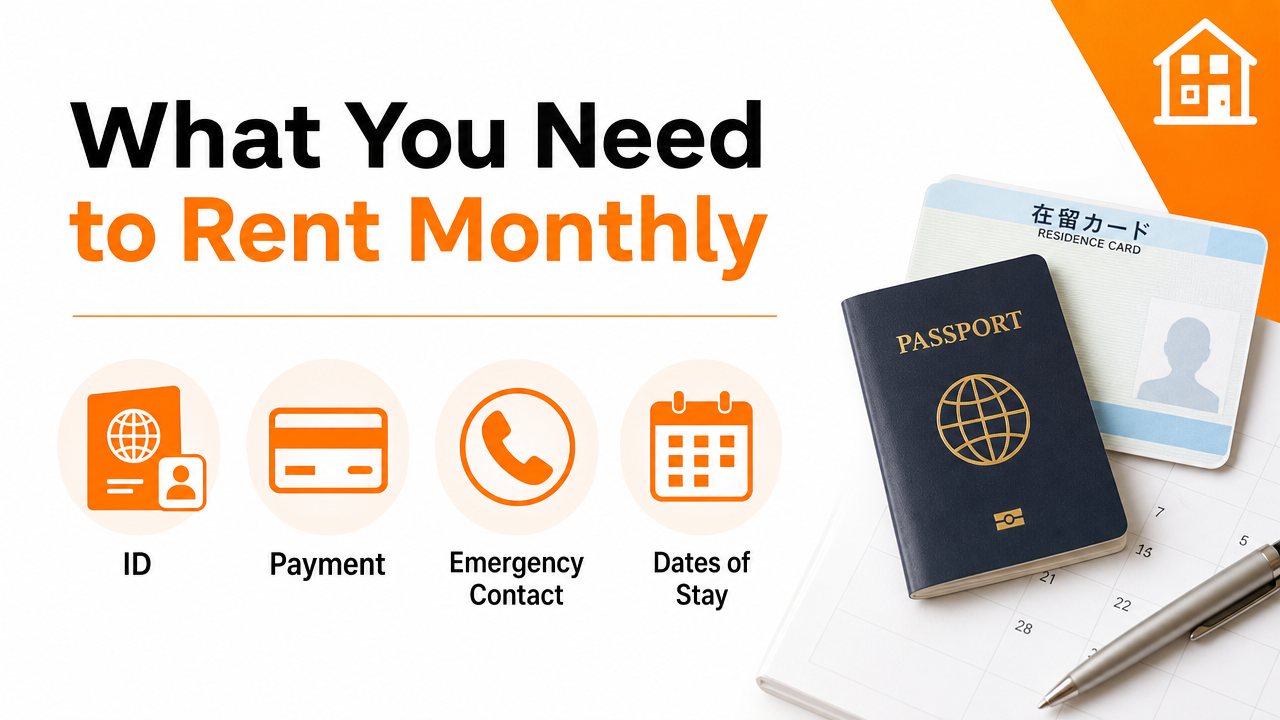
Most monthly apartment operators in Nagoya ask for the following:
| What You Need | Details |
|---|---|
| Valid passport | Or Residence Card (在留カード) if you have one |
| Payment method | Credit card is fastest; bank transfer also accepted |
| Emergency contact | A person to call in urgent situations — not a legal guarantor |
| Dates of stay | Move-in and move-out dates confirmed in advance |
That’s the standard list. Some operators accept a scanned copy of your passport sent via email; others ask you to bring it on move-in day.
What You Do NOT Need

| What You Don’t Need | Why It’s Waived |
|---|---|
| Japanese guarantor | Prepayment eliminates default risk |
| Japanese bank account | Credit card or international wire transfer accepted at most operators |
| Proof of employment | Income verification is irrelevant when payment is upfront |
| Work or residence visa | Tourist visa is accepted at most properties for stays within visa validity |
| Long credit history | No credit check is performed |
| Key money (礼金) | Monthly apartments don’t charge non-refundable move-in fees |
| Security deposit | Included in the upfront fee at most operators; no separate deposit |
The absence of these requirements is not negotiable risk-tolerance — it’s a feature of the business model.
What If You Have No Japanese Bank Account?
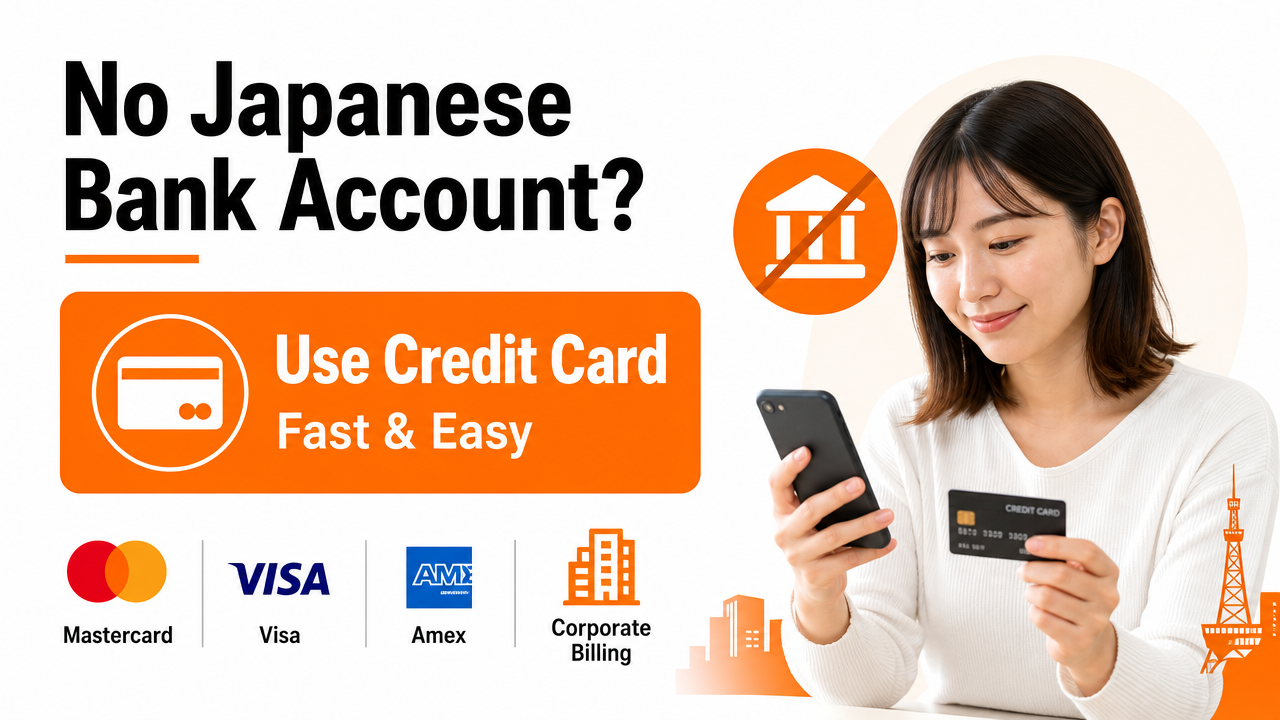
Most monthly apartment operators in Nagoya accept credit card payment (Visa, Mastercard, and often Amex). If you’re booking from overseas, this is typically the fastest option.
For bank transfer, you’ll need a Japanese yen account, which can be a barrier for new arrivals. In this case, credit card is the recommended payment method.
If you’re a corporate assignee, your company can often pay directly on your behalf via corporate invoice — contact the operator to confirm their corporate billing process.
Specific Situations: What to Expect

Newly Arrived — No Japanese Address History
This is not a problem. Monthly apartment operators do not check your rental history in Japan. Your passport and payment are sufficient.
Working on a Tourist Visa
Most operators accept tourist visa holders for stays within the visa’s validity period. If your stay runs up to 90 days (the standard waiver period for many countries including Taiwan, South Korea, most EU nations, and the US), this is generally straightforward.
One thing to note: if you plan to register your residence (住民票) at the address, this is typically not possible on a short-term tourist visa. Monthly apartment stays are usually treated as temporary accommodation, and most operators will confirm whether address registration is available at their properties.
Past Rental Rejection in Japan
A previous rejection at a regular apartment has no bearing on your monthly apartment application. There is no shared screening database that operators check for this purpose. Each application is evaluated only on the documents and payment submitted at that time.
Freelancer or Self-Employed
This is one area where monthly apartments are particularly useful. Regular landlords often reject applicants without stable employed income. Monthly apartment operators don’t ask about income at all — payment upfront is the only income-related consideration.
Step-by-Step: How to Apply
Step 1: Choose your dates and room
Confirm availability for your target move-in and move-out dates. Monthly apartments in Nagoya can often be booked with 24–48 hours notice, and same-day move-in is sometimes possible.
Step 2: Submit your application
Provide your passport (scanned copy or in person), preferred payment method, and emergency contact. The operator will confirm availability and send a quote.
Step 3: Pay upfront
Once availability is confirmed, payment is required to finalize the reservation. Credit card is fastest. Upon payment, the reservation is secured.
Step 4: Receive keys and move in
Most operators provide key instructions by email (key box code or in-person handoff). Move-in can often happen the same day as payment confirmation.
The entire process from inquiry to key handoff can take as little as a few hours for available units.
Frequently Asked Questions
Q: Can a friend or family member outside Japan be my emergency contact?
A: Yes. The emergency contact is not a legal guarantor. An overseas contact with a reachable phone number is generally accepted.
Q: Is there any situation where a monthly apartment might still decline my application?
A: Yes — though it’s uncommon. The main reasons operators decline are: stay period exceeds the property’s maximum term, the property is already booked, or the applicant cannot provide valid identification. Financial screening is not a standard reason for decline.
Q: Do I need to set up utilities separately?
A: No. Monthly apartments include utilities (electricity, gas, water, WiFi) in the monthly fee. There is no need to contract with utility providers independently.
Q: Is English communication available?
A: This varies by operator. When comparing properties, ask upfront whether email correspondence in English is possible. Operators specializing in corporate and foreign-resident accommodation typically have English-capable staff.
Ready to find a monthly apartment in Nagoya with no guarantor required? Contact us directly — we operate monthly apartments in Nagoya and can respond in English by email. You’ll need a passport or residence card and a credit card. We don’t use guarantor-company screening, but we do ask about the purpose of your stay.